
This year, we’re celebrating the 120th anniversary of the Writers’ & Artists’ Yearbook, the essential guide for writers and illustrators looking for advice and practical information about how to get published. Debuting in 1906, the Yearbook was the brainchild of the publisher A & C Black, and in the first of a two-part series, we explore the Yearbook's formative years.
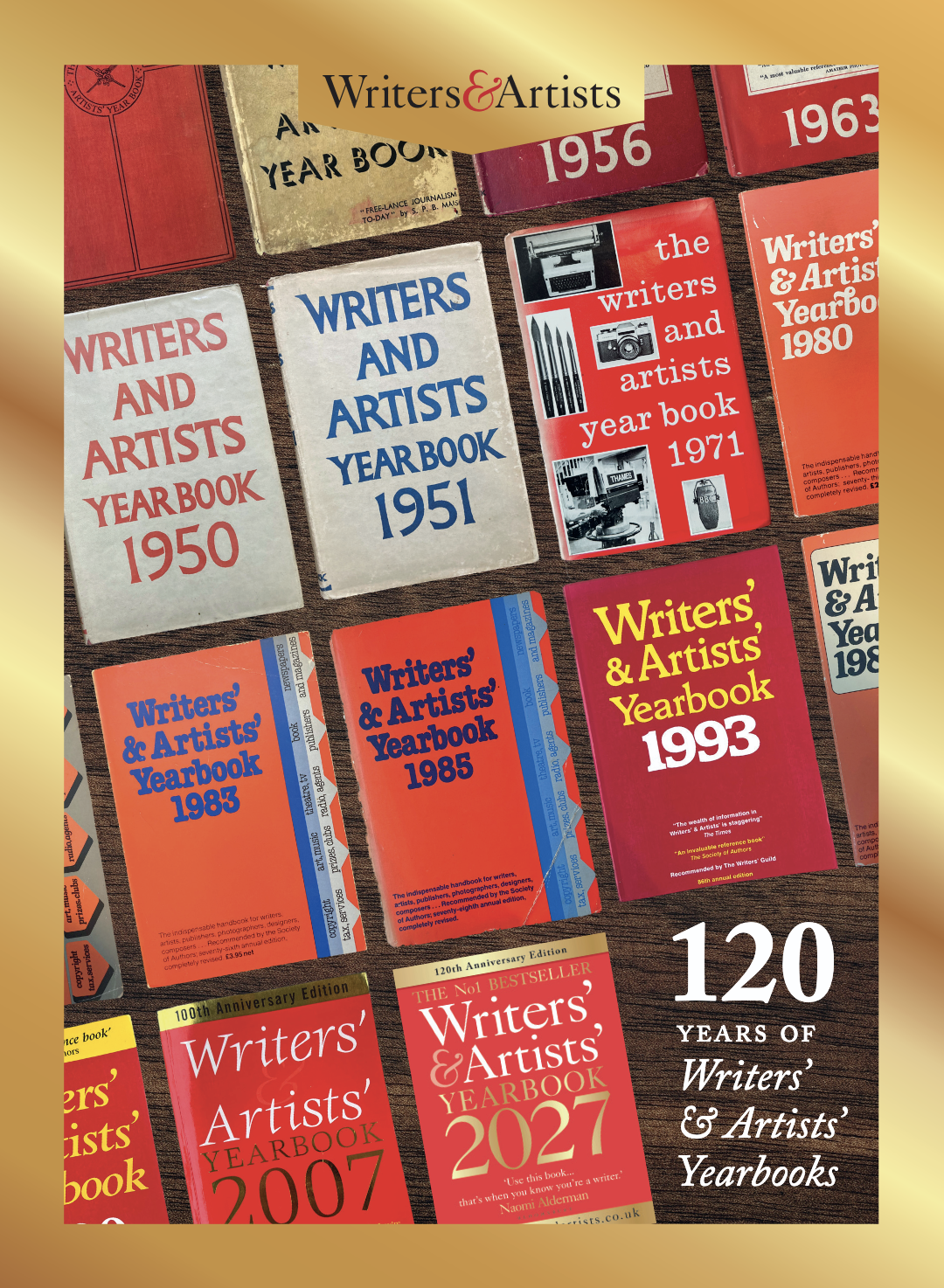
Every book has a story to tell. Though for the Writers’ & Artists’ Yearbook, that story does not lie within its pages – where you’ll find practical advice and literary agent listings as opposed to a rip-roaring yarn – but in its history.
The Yearbook is celebrating its 120th anniversary this year, but its story really begins 220 years ago. In 1807, Adam and Charles Black, an uncle and nephew duo, founded the publisher A & C Black in Edinburgh. The reputation of the publishing house be founded on their publishing of eference tomes. For example, when fellow Edinburgh-based publisher Constable went bankrupt in 1826, A & C Black purchased the copyright in the Encyclopaedia Britannica and took over production of its 7th, 8th and 9th editions (1927–1903). From 1839 it published a series of travel books under the name Black’s Guides. The influential Black’s Medical Dictionary was also first published in 1906, the same year as the first edition of the Writers’ & Artists’ Yearbook.
Over the course of the 19th century, A & C Black also began publishing Who’s Who, a publication that, like the Yearbooks, continues to be published under the auspices of Bloomsbury Publishing to this very day. Adam Black Sr, who went on to become a prominent Scottish politician, is said to have resigned in protest in over his sons’ extravagant plans for the Encyclopaedia Britannica’s 9th edition. Nonetheless, the edition sold half a million sets (and was released in 24 volumes, over the course of several years).
With their father stepping aside and business booming, the younger Blacks decided to relocate the publishers to London in 1890, setting up in Soho Square. According to a later obituary of Adam Black Sr, the location was described as an ‘oasis … quiet and pleasantly restful, yet advantageously placed and close to the British Museum’. The Blacks would surely have found it appropriate that two of their most iconic titles, the Writers' & Artists' Yearbook and Who's Who, would go on to be published by Bloomsbury Publishing, originally also based in Soho Square, before moving even closer to the British Museum and the 'oasis' of Bedford Square'
Despite combing through the archives of A & C Black, now held at the University of Reading, the initial idea for the Yearbook has yet to be discovered. Whether it was strategy, whim or a felicitous mixture of both, the first Writers’ & Artists’ Yearbook appeared in 1906: an 80-page paperback pamphlet, already wrapped in its distinctive red cover, entitled ‘Directory for Writers, Artists and Photographers’. It gave the names of only 7 literary agents, and contained the following piece of advice to illustrators creating a Christmas, post or show card: ‘there must be nothing morbid in it’.
The Yearbook as we know it began to take shape over the following years. The original pamphlet, aside from its small list of literary agents, listed newspapers, magazines, UK publishers and just 15 US publishers. Art agents were first listed in 1909, and Canadian publishers in 1910. Advice articles made their debut in 1911, with ‘The Law of Copyright’, explaining the 1886 Berne Convention for the Protection of Literary and Artistic Works, to which the UK was an original signatory. Ever since, the Yearbook has been committed to legal, copyright and (later) financial matters that impact the writer and artist. In 1913, the Yearbook’s Editor was named on the title page for the first time: G.E. Mitton. Geraldine Edith Mitton (1868–1955) was a novelist, biographer and editor who had been at A & C Black since 1899.
The 1914 edition, the first to be published in wartime, contained a new article on ‘cinema-playwriting’ and a note that ‘on the whole there has been less change owing to the war than might have been expected’. A ‘field for the free lance’ article appeared in 1921. The 16th edition, in 1923, saw the advent of a new editor: Agnes Herbert OBE (1873–1960), another remarkable woman, was a travel writer and big game hunter.
In 1924, A & C Black contributed books to Queen Mary’s Dolls’ House. The Yearbook was by then expanding to include listings for literary prizes and repertory theatre, as well as an article of the ‘Technique of the Sermon’. The first inklings of the Children’s Writers’ & Artists’ Yearbook, not launched until 2003, glimmered in the 1926 article ‘Advice on writing for the Juvenile Market’.
A photograph I saw at the A & C Black archive, taken in 1928 of the Publishers’ & Booksellers’ Golfing Society, captures the Inter-War world of the publishing house well. Trailblazing editors Geraldine Mitton and Agnes Herbert are absent from this all-male snapshot. An Adam Black, perhaps the grandson of the old patriarch, white-haired and bespectacled, sits amongst his plus-four wearing pals. Tantalisingly, two younger men, each with a pipe between their teeth, are also named as ‘Black’, though my research hasn’t been able to discover what, if any, relation they were to the publishing dynasty. The world they sit in is a peaceful, conventional one of friendly rivalry between Booksellers’ golf clubs. But the Second World War is on the horizon, and unlike in the First, there will be much change for the Yearbook and its publishers.
Comments