
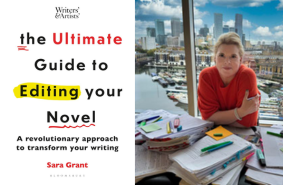
In this exclusive extract from The Ultimate Guide to Editing Your Novel, Sara Grant explains how to assess the concept of your novel with a big picture analysis.
Is it a story?
You may think that this is a simple one. But stories are more than having a beginning, a middle and an end. In his brilliant book Revision and Self-Editing for Publication, James Scott Bell offers this deceptively simple Fiction Formula:
Concept + Character x Conflict = Novel
Let’s test your novel with Bell’s Fiction Formula. Bell defines, ‘Concept is the big idea, the basic premise, the one-liner that will explain your story.’ Sometimes expressed in a what would happen if … ? statement.
Examples of concept:
- What would happen if two girls on holiday follow a rainbow and discover a fairy who needs their help? Answer: Rainbow Magic
- What would happen if in eighteenth-century London, an heiress and a girl whose family owns a tea shop see something suspicious during a play and realise they must prevent a murder? Answer: The Lizzie and Belle Mysteries: Drama and Danger
- What would happen if a poor boy found a golden ticket for an exclusive tour of the world’s most amazing chocolate factory? Answer: Charlie and the Chocolate Factory
- What would happen if a 16-year-old girl takes her younger sister’s place in a deadly game of survival that’s broadcast live to a dystopian world? Answer: The Hunger Games
What is the concept of your novel?
Can you write the concept of your story in a simple one-liner?
Do you have a compelling protagonist?
Of course you have a main character, but is she/he/they intriguing enough to entice us to read your novel from the opening paragraph to the bitter and brilliant end? We will spend an entire chapter on developing your character more fully, but for now a little quick test.
In Revision and Self-Editing for Publication, Bell notes that great characters have three things: 1) grit, 2) wit and 3) it.
- According to Bell, ‘Grit is guts in action’.
- You probably understand what wit is: a warm, natural humour.
- And finally it – that spark, that something special about your character.
Bell’s definition of great characters always makes me think of Mattie Gokey from Jennifer Donnelly’s Carnegie award-winning novel, A Gathering Light (A Northern Light in the original US edition). Mattie is a lover of words and a solver of mysteries who is determined to chase her dream despite mounting odds. I also adore the lively, number-loving Anisha Mistry in Serena Patel’s Anisha, Accidental Detective. And who can forget the hysterically dramatic Noah Grimes in Noah Can’t Even by Simon James Green?
So what’s special about your main character?
And finally … the conflict! In life we try to avoid it, but on the page we need it. Defined simply, conflict is the main problem facing your protagonist. A few examples:
- In Ashley Thorpe’s The Boy to Beat the Gods, the protagonist Kayode must battle a series of gods to save his younger sister.
- Each book in the Beast Quest series finds Tom and Elenna freeing a beast.
- The main conflict in Stephanie Meyer’s Twilight ignites when mere mortal Bella falls in love with a vampire.
What’s the main conflict in your story?
Your story must have all three elements in Bell’s formula – interesting concept, great characters and conflict. If you had difficulty responding to any of these questions, they may point to what needs attention in your novel. Don’t worry, the rest of this book will help you figure out any problems you identify.
There’s a line in Karl Iglesias’ Writing for Emotional Impact that perfectly sums up what makes a great idea: ‘A great idea should be uniquely familiar, and it should promise conflict.’
You’ve noted the main conflict in your story above. Check! Now consider whether it’s uniquely familiar. I love this phrase. It defines ideas that connect with all of us, universal experiences that transcend time but have a twist that’s new and fresh.
Is your idea uniquely familiar? if so, how?
Writer, editor, lecturer and mentor Sara Grant is the author of The Ultimate Guide to Editing Your Novel: A revolutionary approach to transform your writing, which will be published by Bloomsbury, June 2025. Dark Parties, her first young adult novel, won SCBWI Crystal Kite Award for Europe. Publishers in the US, UK and Europe, including Scholastic, Little, Brown and Orion, have published ten of Sara’s books for children/teens. As a freelance editor of series fiction, she has worked on fourteen different series and edited nearly 100 books. She’s the Talent Manager for Storymix (storymix.co.uk), an inclusive fiction studio. She’s taught master’s courses on writing for children/teens at Goldsmiths University and the University of Winchester. She has given writing workshops in the US, UK and Europe. She co-founded Undiscovered Voices – which has launched the writing careers of more than a hundred authors and illustrators, who now have published more than 400 children’s books. (undiscoveredvoices.com)
Comments