
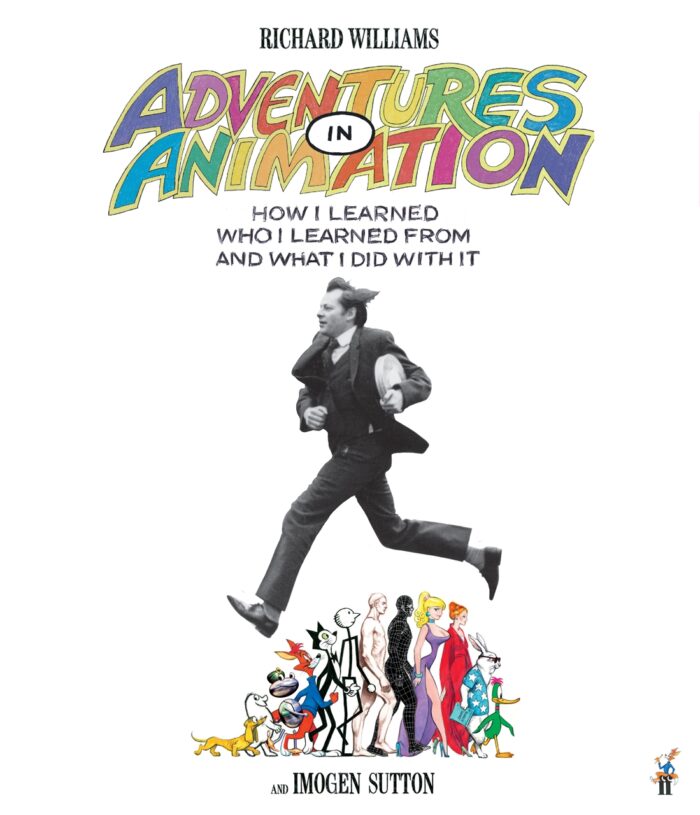
In this exclusive extract from Adventures in Animation: How I Learned Who I Learned From and What I Did with It, Richard Williams discusses the influence of legendary animator Art Babbitt.
Art Babbitt didn’t have a Disney philosophy of entertainment or a way to draw – he taught with stick figures.
Now somebody like me, who is a kind of fancy draughtsman, when I had to do stick figures it exposed all my weaknesses, because I couldn’t be facile. I had to do just like everybody else – a stick figure.
I remember in one of Art’s first classes, I had the worst test out of forty people because I couldn’t show off.
Teaching with stick figures is devoid of style so you put in whatever style or preference you have. Art gave you the bones, the structure to be an artist.
Art said, ‘I had to make a choice: mechanical, medical, physics, military – or to entertain. I chose to entertain.’ This was a man who meant business.
Art was a contradictory kind of fellow. A very great animator and a wonderful teacher. He was tough as nails but very kind. His patience with his students was beautiful. He was theatrical but at the same time down to earth. An intellectual, well-read person, yet a physically tough marine master sergeant. He was devoted to the craft of animation as developed and practised at Disney’s -- yet he was the strike leader against Disney in 1941. Self-deprecating, but you knew he knew his worth.
Art’s animation dictum: ‘First learn the rules and then learn how to break them.’ [...]
Art was one of the pioneer animators – one of the discoverers and developers of the ‘vocabulary’ of animation – but, as a result of his union activities and his battles with Walt, he’s been written out of the official histories as someone not really to be mentioned, usually referred to as ‘the animator’ or ‘one of the animators.’ However, there has been some recognition in these later years of his contribution to the field. [...]
Disney was rapidly expanding and attracting talent from all over America to work with his already famous characters; Art travelled to the West Coast on a one-way ticket in 1932. He got a job (but only as an assistant animator) by sending a big letter to Walt’s secretary to get the boss’s attention. [...]
After only two days he was promoted to full animator. He was one of the four animators who created the wildly successful short The Three Little Pigs. Art and Norm Ferguson and Freddie Moore and Fred Spencer were the young animators who pioneered the development of individual cartoon personalities – like actors – with each animator being assigned a different part in a film. [...]
Art’s exploration of movement helped him transform Goofy from a minor character into a star. Art said, ‘Now Goofy, he was an oaf. He was someone who never knew how stupid he really was. He thought long and carefully before he did anything – and then he did it wrong.’
Art wrote an industry-famous ‘Character analysis of the Goof’ for the other animators. He was the first animator to approach the analysis of a character intellectually: how they felt, moved, what their reactions would be in certain situations.
Get your copy of Adventures in Animation: How I Learned Who I Learned From and What I Did with It by Richard Williams and Imogen Sutton from Faber Books.
Comments