
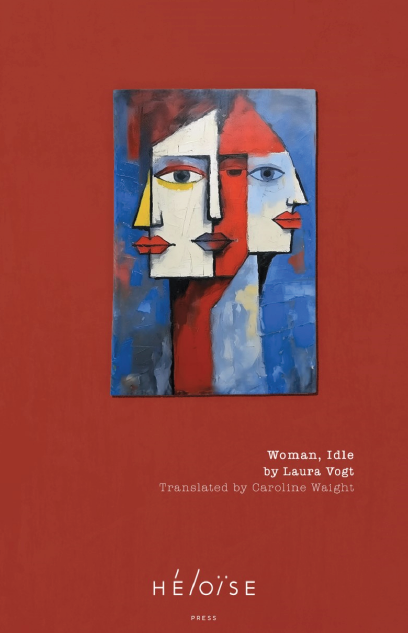
We spoke with author Laura Vogt about her new novel Woman, Idle, and to find out more about her writing process.
- In this novel, we hear the first person perspective of multiple characters: Romi, Szabilla, Phil, Anni. What are the rewards and challenges of writing in these alternate voices?
By telling the story from different first-person perspectives, I was able to expand it beyond a single voice. It was important to me to create a kind of panorama through the different views on the same subject, especially with Szibilla and Romi. Both of them have very different points of view on having children, maintaining relationships, and living a good life. It was so interesting for me as an author to go through these themes with the figures by my side – and let them tell! At the same time, it was challenging to make sure each voice sounded individual: Romi’s more reflective, Szibilla’s more pragmatic, Phil’s different again. I had to constantly listen carefully and adjust the tone so that readers would immediately feel who was speaking.
- The novel is full of excellent dialogue and deep exchanges between characters. Do you have any tips for writers struggling to write authentic dialogue?
Thank you, it’s nice to hear that you like the dialogues! To write authentic ones, I find it important to find a language between the artificial and the everyday. You need to know your characters and their language very well to evoke an authentic picture. As usual when it comes to writing, you should go through the text again and again to find the right rhythm and the most precise wording. I often read my texts aloud, either when I’m alone or together with another writing friend, and check it. It’s a lot of work! But it’s worth it.
- Romi is the only character who uses ‘Notes’ to explore her own observations – what was the reasoning behind this stylistic choice?
The reason lies mainly in Romi’s character and her way of seeing the world. Because she has a strong affinity for text, I thought it suited her. And of course, it gave me as an author the freedom to tell things in another way – since the text is written in present tense, I usually had to follow a certain line, but Romi’s notes don’t need any chronology, so they enabled me to break out a little. I loved writing them because they are very free in their form, very fluid and also playful.
- The complex, painful, but loving friendship between women are brilliantly explored in this book. What is your process for creating characters and establishing different relationships?
I always start work on a novel with the creation of the characters. In Woman, Idle, it was Nora and Szibilla. I usually just start writing and let the language flow. This is how I find out what concerns them, where they live and who they are. After some time, I start working more precisely and try to find a plot for the story. It’s a process of discovery that involves writing a lot – and deleting a lot. When I wrote Woman, Idle, a third main character suddenly appeared: Romi. It didn’t surprise me much, since I went through a situation comparable to Romi’s. On her and Szibilla’s behalf, I learned a lot about love, life, society – and myself. The novel is a mixture of researched material, experiences of friends, observations, my own experiences, and pure fiction.
- There are reoccurring themes in your work, especially around women’s bodies, pregnancy, fertility and mental health. What draws you to writing about these experiences?
These topics concern me a lot – as a woman, a friend, a mother, a daughter and sister, as a human being. In my opinion, it’s so important that these subjects take up more space in literature – because they are not “women’s issues” but “human issues.” I touched on them in my first three novels in very different ways, and they have become central to shaping my literary voice. Now I make new steps, I think. My next novel will be quite different – although I must admit that, as an author, you never really leave certain themes behind. And I think that's okay. One book builds on the next, even if that's not always apparent from the outside.
What is your writing process like? How does an idea bloom into a story for you?
When I work on a novel, I try to write every day to keep the engine running, as I like to say with a wink. I am more concentrated in the mornings, so I start as soon as I can – which is not always as soon as I wish, because I have two school children. First, I just write and let it flow. Then I begin to understand what I want to write and where the essence lies. The text begins to grow. I often stay in touch with my agent, who’s a brilliant reader. Her questions enable me to go further. Sometimes the text grows, sometimes I have to cut large parts and find a new way forward. I love the periods when I’ve found the tone and the form – when I’m totally inside the text and just write! But I always know this phase will end and I’ll have to revise again and again. Most of the job for me as a writer is not writing, but revising.
- How do you find the experience of your work being translated?
It’s fantastic! It’s like a gift, or the whipped cream on top of the cake! To hold the translated book in my hands is something magic – it’s my book, my work, but it has transformed. Someone has read every word, every sentence carefully and brought it into a new form – also with so much work and passion. I admire the patience and creativity of translators – especially Caroline Waigh, my English translator. She opens my text to a new world of readers.
- What’s next for you, writing wise?
I just finished my new novel, which will be published in February or March 2026. It’s very different from Woman, Idle: a poetic yet narrative story about a grieving process. It’s a very personal book about the story of a family, textually interwoven with a material extracted by humans for thousands of years: lime. It’s a book about death and life, about mountains and family, the processes of earth and our individual processes.
Laura Vogt studied cultural studies and literary writing. Her debut novel, So einfach war es also zu gehen (2016) featured at the Solothurn Literature Days and PROSOMOVA. In 2022, Héloïse Press published her second novel, Was uns betrifft in English (What Concerns Us). In addition to prose, she also writes poetry, plays, and journalistic texts. She lives with her family in eastern Switzerland.
Comments