
We spoke with writer and Raven writing app creator, Brad Harris, about some of the biggest obstacles that writers face when writing a first draft and how his own writing struggles were the catalyst to creating a new writing app.
How did the idea for Raven come about?
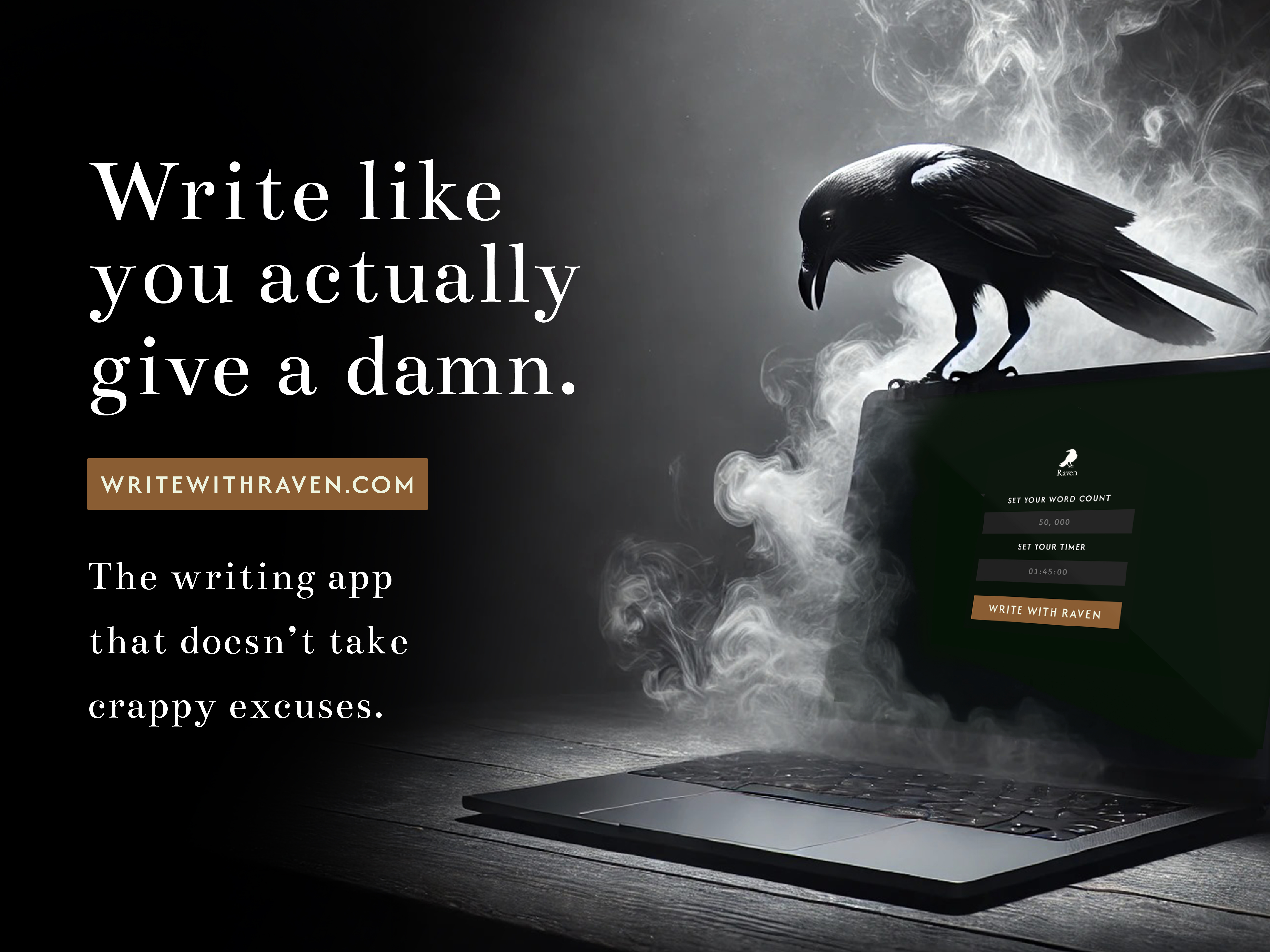
A couple of years ago I got frustrated. Not mildly dissatisfied. Properly frustrated with every writing app I tried. They were either bloated with features nobody needed or, while decent enough, lacked the one thing I needed. I wanted to actually finish. Nothing helped. So I taught myself to code. Raven exists because I needed it. As a publisher at Imagnary House, and an author myself, I spend a lot of time evaluating manuscripts, which means I'm very aware of the gap between what a writer intends and what actually ends up on the page. If I open a writing app and spend forty minutes adjusting fonts, or edit chapter one for the fourteenth time instead of writing chapter two... it's not a tool that I want. I didn't need another feature. I needed stakes. That's Raven.
What are some of the biggest obstacles that writers face, in your opinion, when writing a first draft?
Mostly ourselves. The first draft is where most of our books die (usually around 20k to 30k words). Perfectionism is the worst offender. We so often treat a first draft like it needs to survive contact with an editor, when what it actually needs to be is finished. The urge to edit as you go kills forward momentum (not saying there's no place for it ever; but there's certainly no place for it if you can't finish a draft). Inconsistency has also been a huge drainer on my writing and authors I've developed. Writing in bursts (a thousand words one Saturday, nothing for three weeks) means you spend half your sessions just finding your footing again. Writing regularly matters more than volume, even if the daily count is modest. The last one I'll mention is stakes. Lack of consequence. If I never finish a draft... so what? Without something genuinely at stake, it's too easy to stop. You can always write tomorrow. Tomorrow is very understanding. It never judges you. Raven gives you something to answer to.
What are the challenges of creating an app?
Well, I really should have just been writing. But I built the app to help me write... and it is helping, so perhaps I'm let off the hook. Building Raven as a solo dev means every decision lands on me, which has been more freeing than exhausting. I knew enough of coding and product design to get a good start, and so the technical side was manageable for me (though a stretch). The first challenge was holding back on features, because there are a million things you can build... but I wanted Raven to be specific and focused on one goal; finishing a draft. I always ask myself, "Will this encourage writers to actually write?". If not a resounding "Yes!", then I scrap it. There's the added constraint that makes Raven unusual: end-to-end encryption, which means I (or the app) cannot read user content. That's a genuine privacy commitment, but it also means every insight the app offers has to come from arithmetic alone. That was a challenge, but while AI was useful in helping me build Raven (with coding challenges that were beyond my skill), I was committed to ensuring no AI exists within Raven. So, there's no language model reading your drafts, or ever will be. It was tough. Designing a meaningful feedback system inside this constraint has been incredibly challenging and satisfying.
What do you hope that writers will get out of Raven?
A finished draft. That's it. That's the whole ambition. Not a better relationship with productivity, not a curated writing identity, not data about their habits. A finished first draft of something they've been meaning to write. Everything else (the encryption, the consequence modes, the absence of AI) is in service of that single outcome. Most writing apps build for engagement. I built for completion. Writers who finish are writers who can be published, who can improve, who can actually call themselves writers with some evidence to back it up. Getting them there is the point.
Raven will be hosting a 30-day writing challenge from 1st June. If you want to take part, here's what you need to do:
- Head to Raven's challenge page
- Register for free and make a public word count pledge. The outcome (UPHELD PLEDGE or ABANDONED PLEDGE) is posted on a public board with your name, so be ready to be held accountable!
Brad Harris is a publisher, product builder, and technologist who has spent a decade finding creative problems worth solving, and then building the tools to solve them. As Founder and Publishing Director of Imagnary House, he set out to fill a gap in authentic African children's and YA storytelling. What followed was a publishing house that now spans 16 languages and 13 countries, with a roster of 60+ creators and a 2025 Bologna Prize for Best Children's Publishers of the Year to its name. At Right on the Line, he leads the Technology Solutions team; designing AI integrations, automation strategies, and data systems for global B2B marketing campaigns. Raven came out of a simple, stubborn problem: he needed to write, and nothing he tried actually made him. So he bootstrapped a minimalist writing app in vanilla JS. It was built around real accountability mechanics, genuine consequences for procrastination, and zero tolerance for the usual excuses. With his publishing and technology experience, and a Master's in Creative Writing (UCT), Raven was the perfect overlap (or so he hopes!).
Comments