
We spoke with debut author Miranda Reason about writing her YA post-apocalyptic story Day of Now.
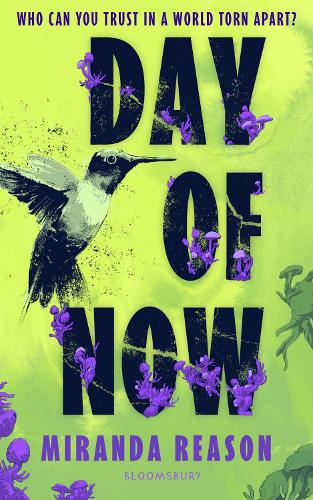
1. Day of Now is your debut novel. Could you talk us through the process of writing it – from initial idea to finished draft?
Well, I had this idea about two siblings growing up in a wild, largely abandoned world after some catastrophe had wiped out most of society. They couldn’t remember the time before, but they imagined it as this wonderful, magical place because of their father’s stories, which were retellings of films, TV series or novels. And the kids lapped these stories up and half-believed in them. I liked the idea of making pop culture into legends and myths.
As for the dystopian world itself, I wanted something like zombies, but not undead – just rabid, frenzied and infectious. I also thought it would be interesting if animals as well as humans could be infected, as you don’t see that so often. The fungus and spore mist was probably somewhat inspired by The Girl with all the Gifts and The Last of Us, but I only made that connection much later.
So, that was my starting point. All I knew at the beginning was that I wanted to send these siblings on an adventure through their dangerous world, and when their journey began, I only had the vaguest idea of how it would end. So I just wrote and saw where it would take them (and me). Dayna, my protagonist, proved much more resourceful than I’d expected – I kept writing them into impossible situations, and she kept getting them out again. Of course, she was also quite naïve when it came to trusting people (at least at the beginning) because apart from her family, the only people she ‘knew’ were the pop culture heroes of her father’s tales.
Everything just slotted into place, as if the story knew where it was going long before I did. There’s a twist at the end, which I really didn’t see coming until I’d almost reached that point – so I was just as surprised as my characters!
2. Your opening line ‘The first sign of life in the outside world – of other people who are still, at this very moment, living – comes from the radio’ immediately grabs the reader’s attention and pulls us in. Do you have any favourite opening lines? And what advice would you give writers who want to start their story with a bang?
Oh, two very different novels with great opening lines immediately come to my mind:
One is Charles Portis’ True Grit:
‘People do not give it credence that a fourteen-year-old girl could leave home and go off in the wintertime to avenge her father’s blood but it did not seem so strange then, although I will say it did not happen every day.’
You know what’s going on straight away, that the protagonist is a tough 14-year-old girl, and that what she’s about to experience could be pretty interesting.
The other is P. G. Wodehouse’s The Luck of the Bodkins:
‘Into the face of the young man who sat on the terrace of the Hotel Magnifique at Cannes there had crept a look of furtive shame, the shifty, hangdog look which announces that an Englishman is about to talk French.’
This one just made me laugh, which you don’t expect to do after just one sentence. (Not even in most other Wodehouse books I’ve read - you’ll usually have to wait until the second sentence at least).
It feels a bit strange to be giving advice on starting stories with a bang – it depends so much on the individual story, I think! But the way I went about it is this: imagining the reader has no idea about the book they’ve just sat down to read – they don’t even know the blurb or the genre – and then trying to convey the feeling of the story in the opening line, preferably even giving them a bit of a surprise about what they’ve stumbled into.
3. What type of research did you do for creating the post-apocalyptic setting? Do you have any tips for writers who want to create authentic-feeling settings?
I knew from the start that I wanted to use – or reuse – authentic settings, because that made this whole world I was creating more believable. As a film buff, I was also sort of thinking in terms of on-location shooting, or ready-made film sets – I had free rein of all these impressive buildings and places, anywhere I liked, and could have my characters explore them. All I had to do was imagine them overgrown, neglected and in some cases repurposed, and describe them as Dayna would.
So, a lot of my research consisted in choosing places and buildings, and finding out as much as I could about the layouts – though I also had characters change them again for their own purposes; in one case I even added a fictional restoration, because I wanted part of a building to look like it had in the 1930s.
I worked a lot with Google maps and images for impressions, distances, and/ or memory jogs. I also visited many of the main settings myself, but that was only after finishing the first draft, as I don’t exactly live around the corner any more. So Google maps, especially street view, is something I’d recommend to people wanting to use real locations, or semi-real locations. Of course, going yourself too, but for a first impression or for rechecking, street view is great and gives you small details you might not think you need until you’re actually sitting down to write the scene.
As for the whole dystopian setting, I watched films and read novels for inspiration, research and entertainment, just to get a feel for the genre; though that happened parallel to writing, and also continued after I’d finished the first draft – it’s an exciting genre!
4. At the heart of your story is the sibling relationship between Dayna and Pax. How did you develop them as individual characters while also keeping the dynamic between them at the forefront of the story?
Well, I wanted Dayna and Pax to have a typical sibling relationship (or what I remember as being typical, from growing up with my brother), only in a post-apocalyptic scenario. So they can bicker, tease or irritate each other, but at the same time, they work really well together in dangerous situations, and they also just understand each other like no one else does, because their life until this point was so isolated; they more or less had the same influences: their father’s survival training, and his stories. They’re still their own characters – Pax always has to be on the move and doing something, and Dayna is more reflective and resourceful. She’s also older and gets annoyed when her brother ignores or sides against her, so that dynamic really wrote itself. But all in all, they start off very much on the same page.
I could use their similarities to highlight the effect their journey has on Dayna. As she’s the older of the two, she sees herself in charge (and Pax accepts this, at least in hostile environments), which means that she has to deal with all the tough decisions that come their way, and becomes increasingly unsure about the right thing to do: Who to trust, when to prioritise their own safety. Pax, who still tends to see things in a simple, straightforward way, then becomes a reminder of how Dayna has changed; she’s become more distrustful, more careful, more scared.
5. What was your favourite part of the story to write? Equally, what was the most challenging?
My favourite parts to write would probably be the action sequences; they’re exciting, can advance the plot pretty rapidly, and I could make Dayna’s impressions seem more urgent, disjointed or fearful. Of these sequences (there are quite a few in the book), I most enjoyed writing a confrontation in Trafalgar Square, between the kids and a group calling themselves the Undead. I’m actually not quite sure why, but I remember it being really fun to write; just the overall tension, and the Undead’s reaction to the kids, who (seemingly) have the upper hand.
The most challenging scene was one towards the end, another confrontation, but only a verbal one. I’ll keep it vague to avoid spoilers, but for Dayna, it’s both a shocking and emotional moment, and also a kind of battle between her younger self and this new, more wary person she’s become. Especially that struggle was difficult to get right, but I’m really pleased with the scene now.
6. How do you find the editing process? How many drafts did it take to reach the final version of Day of Now?
I’m not quite sure how many drafts I wrote of Day of Now on my own before I found my literary agent and he got Bloomsbury YA involved. I’d say 2-3, plus smaller revisions – which is a very low number for me (the sequel already has more). Then, together with my Bloomsbury editors, the story went through quite a few editing rounds. I think I’d qualify another 2-3 as new drafts (though these were much more in depth than the drafts I’d done by myself), plus smaller revisions and changes.
Initially, I was nervous about the editing process at Bloomsbury, but ended up really enjoying it. One big thing that had to be done was shorten the story to about 100k words – my original manuscript was 127k – for pacing and a more YA-friendly word count. I had no idea how this was going to be done without losing too many important moments, but my editors had some brilliant suggestions, and now I very much prefer the new version (especially the scenes I wrote to replace the longer ones we cut). My editors understood the characters and what I was trying to do with the story, and they always listened when there were changes I didn’t want to make, so the whole editing process turned out to be a very rewarding experience – and fun too; it just felt like everyone was working together to make the story as good as it could be.
7. What was your journey to publication like?
Well, I started writing after finishing school, and found that I really enjoyed it. A writer friend of mine read one of my early manuscripts and gave me a lot of useful feedback and encouragement, but other than that, I just wrote, reread and rewrote until I was happy with my stories. I shared them with a couple of friends who were interested, and my parents, but mostly I just wrote for myself. Around 2014 I first began to toy with the idea of trying to find a literary agent – I know the year, because I still have the Writers’ & Artists’ Yearbook of 2014 (recommended to me by my writer friend). I did send out queries, but just got rejections (though two encouraging rejections did cheer me up a bit), so I thought I’d just try with something new at a later point, and moved on to the next story. I wrote the very first draft of Day of Now in 2021 and 2022, and thought it might be good enough to try out for literary agents again. Which I did towards the end of 2023 – it took that long because I worked on another 2 drafts of the book, had a busy year at my day job and also kept putting off the actual queries; I assumed I was probably going to be rejected again. Which I was, by most of the agents I sent the first round of queries to, except for one, Oli Munson of A.M. Heath, who was really enthusiastic about the book. He soon got Bloomsbury YA involved, and here we are. All of this still feels pretty amazing.
Miranda Reason grew up in an Anglo-German household, spending part of her childhood living in Hastings on the coast of Southern England and part in a small village in Bavaria. Alongside writing and reading, Miranda is passionate about films and film history. She works as a film restorer of classic German movies. Although now living in Germany, she still prefers English for writing and storytelling, thanks to all the classic and contemporary English children's books her dad read to her as a child. Day of Now is her debut novel.
Comments