
Debut author Gosia Buzzanca discusses the creation of her memoir.
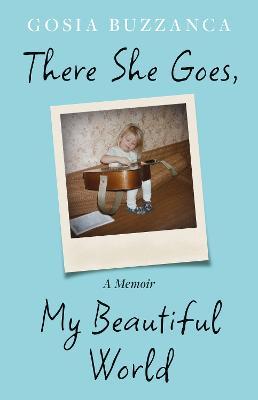
There She Goes, My Beautiful World, my debut book, a memoir weaving my experiences of growing up in Poland and becoming an adult in the UK is out in one month. This is a book I knew I had to write before I could move on to writing anything else, a story that was stuck in my head every day, sometimes hauntingly, sometimes encouragingly, mostly just pleading me to get it out to the world.
More often than not writers rely hugely on their personal experiences to write their debuts. Not many people start with an outright memoir and there’s a few reasons for it. The market prefers memoirs written by people known and celebrated, so it can be harder to find a home for it. Some writers might be afraid of being too vulnerable in their debut and fiction offers a level of safety and freedom in that regard. Different people may be perhaps afraid of the craft itself.
Beginning with a memoir took guts. And I attempted writing There She Goes as a novel at first, but this didn’t last long. The feeling I had was that the book would be closer to the bone if presented as what it was, a true story. So I rolled with it. I only lacked a container — a right structure — to fit it all in, seeing as memoirs can span across years. There is a need to be picky, but still specific. Every choice made has to be made for a good reason.
There She Goes, My Beautiful World is — spoiler alert — written in three different points of view, across multiple years. I begin in the 90s Poland, where I write in second person. The first part of the book talks about my core childhood and adolescent memories, and I picked ones I knew I could cross-reference in the following parts of the book.
The first part of the book means so much to me, because it is a sort of a letter to my younger self. Writing in the second person helped me, because It allowed me to feel detached and neutral as I retell the memories, sometimes painful and outright traumatic, from the understanding of an adult, but with the innocence and attention to details of the child and teenager that lived them. This was also where I began writing the book all the way in 2022, and a fragment of it won the W&A Working-Class Writers’ Prize that year. It will forever be special to me for a plethora of reasons.
Part two of the memoir takes place entirely in Wales and is written from the third point of view, where I become a character, observed rather than observing — Gosia becomes G, a grown woman. In the final, shortest part of the book I go back to Poland as an adult and for the first time I write in the first person point of view, which is the way most memoirs are usually written.
As I worked on the manuscript I played with multiple ideas and versions of the structure. Only a few days ago I removed multicoloured post it notes from my writing room’s wall and was surprised to remember that for the longest time I planned on interloping the second person POV with a first person POV.
Ultimately I decided against this structure, as I felt it would become too choppy and distractive and my goal was to create a more immersive and accessible narrative. If you’re a writer planning on juggling multiple POV in the same manuscript give yourself clear reasons for it, and clear boundaries for the story and its compartments. Where does one POV end, when does another begin? Why? These aren’t questions designed to trick you, but to help you clarify your vision.
What helped me was deciding on the internal structure for the middle part of the book. I chose to focus on a week writing course I did in Tŷ Newydd Writing Centre in North Wales, a week that culminated in me climbing up Yr Wydffa. This climb, as well as the preparation for the trip and the week spent developing my craft gave me a natural narrative arc for the part of the memoir where I spend a lot of time reflecting on my past. This was part of the book that took the longest to write and edit, but ultimately the most rewarding one to get right.
The final part of There She Goes, My Beautiful World is where Gosia, the character, has finally come to terms with her past and can now revisit it — quite literally in this case — from the safety of the time, distance and healing acquired. This is where I speak as myself for the first time, and get to realise what sort of person I have grown into being.
As you work on your book don’t become too attached to a single structure. Be creative, let your manuscript take you to unknown places. Allow your writing time to breathe, see how it all comes together, experiment. At the same time do not be afraid of simplicity, sometimes the only way to tell your story is straight forward, and that’s more than okay.
One of the most frustrating creative writing truths is that there are no rules. You will know deep in your bones when the thing you work on is right and working out in the best interest for your story. Keep showing up and the narrative form will present itself to you eventually. Don’t give up.
Book recommendations that helped me immensely with writing my own memoir:
Body Work: The Radical Power of Personal Narrative by Melissa Febos
Meander, Spiral, Explode: Design and Pattern in Narrative by Jane Alison
Advanced Creative Nonfiction by Sean Prentiss & Jessica Hendry Nelson
Gosia Buzzanca was born in Poznań, Poland. She began publishing short stories in 2002, before moving to the UK in 2008. She earned a Creative Writing MA with distinction and was a recipient of the W&A Working-Class Writers’ Prize in 2022. There She Goes, My Beautiful World is her first book. She now lives, works and writes in Barry, Wales.
Pre-order There She Goes, My Beautiful World
Comments