
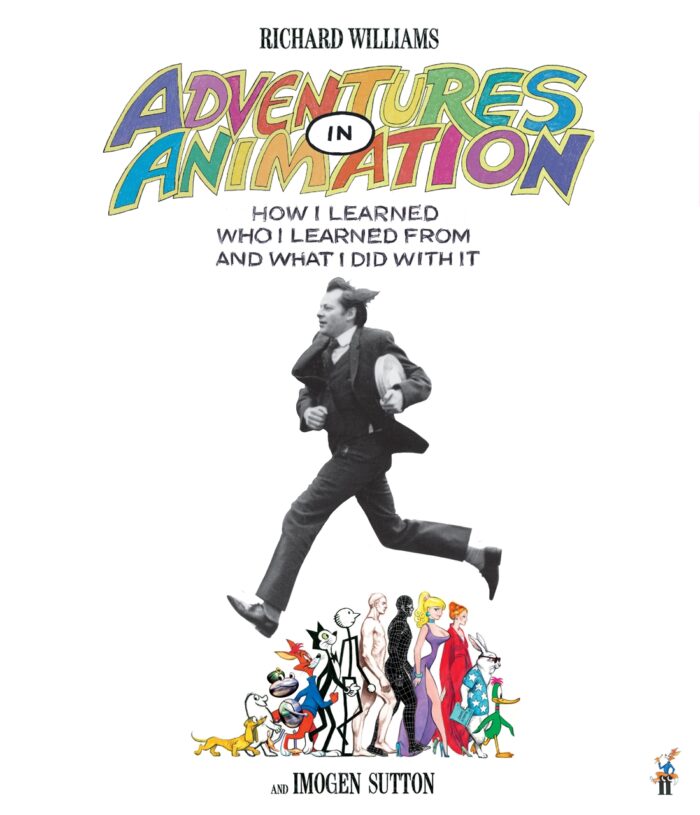
In this exclusive extract from Adventures in Animation: How I Learned Who I Learned From and What I Did with It, Richard Williams recalls one of the biggest opportunities of his career: working on Who Framed Roger Rabbit.
My next huge opportunity came in 1986 with Who Framed Roger Rabbit. Disney had developed the project for seven years and Robert Zemeckis worked on it when he was younger. Then he said, I’ll see you guys later,’ and left.
At that time Bugs Bunny was the top animation character in the world so why, for a start, would they try and do a grey rabbit? So the thing languished. Then Zemeckis did Back to the Future, which was very big. He was a protege of Steven Spielberg and wanted to get the rights from Disney, so they – Spielberg and Disney – had made a temporary marriage and were looking for an animation director. But I didn’t want to do it.
I said to Zemeckis, ‘I love the early Disney movies – Snow White, Dumbo, Bambi, Pinnochio, Fantasia.’ But I thought the animation in Mary Poppins was awful. The cartoons look pasted on. They look like they’re on a piece of glass in front of the characters.’ I said to Zemeckis, ‘You’re mixing the two realms and they don’t fit. It demeans the animation and it also wrecks the live action. This pasted-on business is just no good.’
He replied, ‘But have you seen Star Wars – Return of the Jedi, with the motorbikes flying through the forest?’ He said, ‘Industrial Light & Magic have figured out a way of printing the cartoon thing, the drawn thing, so that it fits into the live action. They expose it differently, so you’ve got the different levels working.’ And I said, ‘Well, then we can do it.’ And Zemeckis said, ‘In Mary Poppins, the penguins are actually animated beautifully because they got the eyelines right.’
So when Bob Hoskins is looking at the animated characters in Who Framed Roger Rabbit, you believe he is interacting with them. He had this wonderful ability to stop his eyes right at the belt line which was at the level with the Rabbit’s eyeline. I asked him, ‘How did you get that concentration?’ He said, ‘Don’t make me think about it or I won’t be able to do it.’
Zemeckis said that the animation directors always insisted on having a locked-off camera, so the camera was still, which meant that the animators didn’t have to turn the characters much.
He told me, ‘I’m trying to shoot a modern movie where the camera’s moving all the time,’ and I said, ‘That’s no problem.’ He said, ‘But all the animation directors we’ve talked to say you have to have it locked off.’ And I said, ‘Because they’re lazy bastards.’
He asked, ‘But isn’t it more work?’ And I said, ‘What do you think animation is? It’s nothing but work. That’s our job, turning things in space.’
It was a very expensive technique, this kind of moving camera technique, because it meant that we had to print every frame of the film that we were going to animate. They would print it at Industrial Light & Magic in San Francisco, mail it over to us and we’d have these big drawings, big pictures for each frame – you'd just put a piece of paper on it, and draw a rabbit in there.
Animation is time-consuming, but that was really time-consuming – that’s why there were so many people on it. After every hand-drawn film, they store all the drawings, and with Roger Rabbit they had about three times as many as normal.
It wasn’t 3D, more like 2-and-a-half-D. The animation worked because the characters weren’t quite round. We back-lit, with a sort of rim light, and I’d have to draw them on. It was quite a simple thing, as I figured out. Because a lot of the live action was blurred, the images were blurred naturally. At twenty-four frames a second, it was just going to be a blur. So they said, ‘You can’t put a hard-edged piece of animation into that,’ and I said, ‘Well I already have – strangely enough, on a commercial I animated for Disney, with all the Disney characters playing football’ -- and I’d broken all the rules.
Get your copy of Adventures in Animation: How I Learned Who I Learned From and What I Did with It by Richard Williams and Imogen Sutton from Faber Books.
Comments