
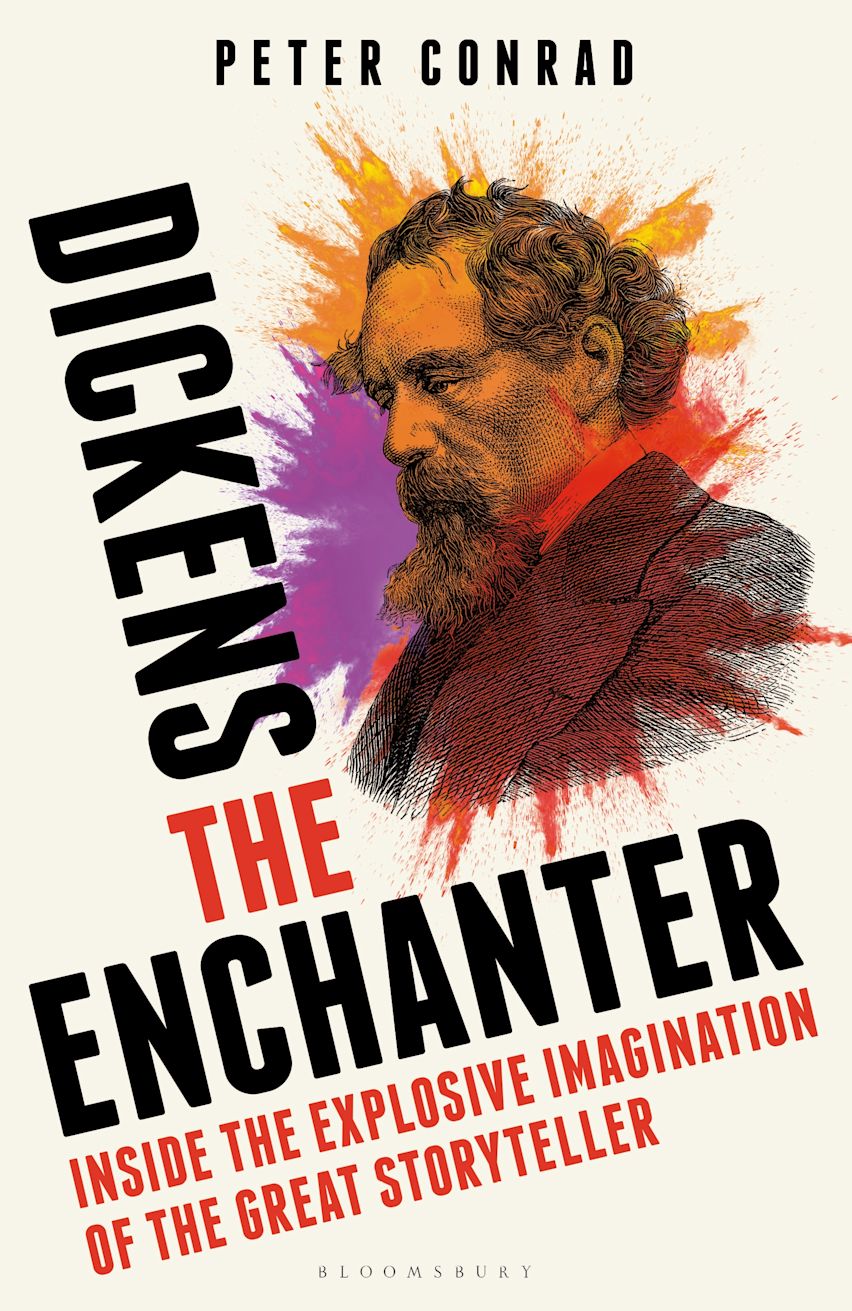
In this extract from Dickens The Enchanter, Peter Conrad shares some of the ways in which Charles Dickens played with language.
In 1859 Dickens fancifully recalled a childhood outing to a bazaar in Soho, during which he made his first attempt to officiate as an enchanter. He says that he coveted a harlequin’s wand as a New Year’s gift; in retrospect he calls it ‘this talisman’, a word that in its Arabian or Greek origins refers to an amulet used in esoteric rites. In remembering – or, more likely, inventing – the incident, he tried out the implement on the bossy minder who accompanied him, hoping that it would turn her ‘into anything agreeable ’, but she remained unregenerate, which persuaded him of ‘the wand’s total incapacity’. Eventually he settled on another way of imposing his will. He exchanged the ineffectual stick for a pen, and used language to charm or change obdurate reality.
Words for Dickens did more than describe a world that already exists. They were magic spells; they even possessed an abstruse and mystical power that looked beyond the appearance of things and spurned intelligibility. […]
Mispronounced or misspelled, words blurt out new meanings. When Pickwick is sued for breach of promise by his landlady Mrs Bardell, who imagines that he has proposed to her, Sam Weller’s father Tony suggests that he needs an ‘alleybi’. Innocuous when spoken, the word when printed opens up an intriguing byway, an alley down which Pickwick might escape. Tony gets entangled in legal and financial terminology after his wife dies, but the words he muddles lighten his cares. Explaining his distraction, he tells Sam ‘I was in a referee’ – not a pensive reverie but an attempt to arbitrate opposed claims, as in a sporting match. Then he discovers a will that appoints him as his wife’s ‘sole eggzekiter’. His word makes execution eggy and edible, with a kite attached as a symbol of aerial frolics. When he contemplates an investment, a dropped consonant converts the funds – a worryingly unstable stock market – into ‘the funs’, where a return in the form of amusement is guaranteed. Eventually he cashes in the bequest and proposes an adjournment to ‘hordit the accounts’. There is no question of hoarding because he is so open-handed, and the audit proves to be a euphemism for taking a drink. […]
Dickens’s characters can be eloquent even when silent, communicating with their whole bodies. In Naples, he marvelled at the beggars whose vocabulary of gestures articulated ‘a copious language ’ with five fingers rather than one tongue. Tony Weller more economically conveys his detestation of the temperance preacher Reverend Stiggins in a ‘perfect alphabet of winks’ […]
Other characters come alive when Dickens notices the odd ways in which spoken words emerge from their mouths. Fanny’s violently plosive enunciation of ‘Pauper!’ in Little Dorrit is like the firing of a pistol. The governess Mrs General has a less aggressive use for the same consonant: she recommends that her female charges should train themselves to be pouty by repeating the litany of ‘Papa, potatoes, poultry, prunes, and prism’ because the alliterating consonant gives ‘a pretty form to the lips’. The landlady Mrs Billickin in Edwin Drood aspirates aspirationally, imagining that this sounds refined. ‘I am as well,’ she announces, ‘as I hever ham.’ Offended when the schoolmistress Miss Twinkleton slights her for lacking ‘accurate information’, Mrs Billickin declares that ‘my informiation, Miss Twinkleton, were my own experience ’. The extra syllable is slipped in, Dickens notes, ‘for the sake of emphasis at once polite and powerful’, just as a crony of the aristocratic rakes in Nicholas Nickleby ends every sentence with ‘hey?’ – a hiccup that gives him the chance to display his gleaming teeth in an almost canine show of menace.
Peter Conrad is a literary critic and cultural historian. His books include The Everyman History of English Literature; Creation: Artists, Gods & Origins; and Modern Times, Modern Places: Life and Art in the Twentieth Century.
Comments